Margaret Moore was born in Chilcompton, Somerset, in 1912. She trained as an illustrator and watercolourist at the Royal College of Art before joining the Ministry of Information at the outbreak of the Second World War. Officially an illustrator of morale posters, she was in fact seconded to Bletchley Park, where her unusual gift for visual pattern recognition proved unexpectedly valuable. She rarely spoke of her wartime work, but friends say it shaped her lifelong suspicion of authoritarianism and her fierce protectiveness of children.
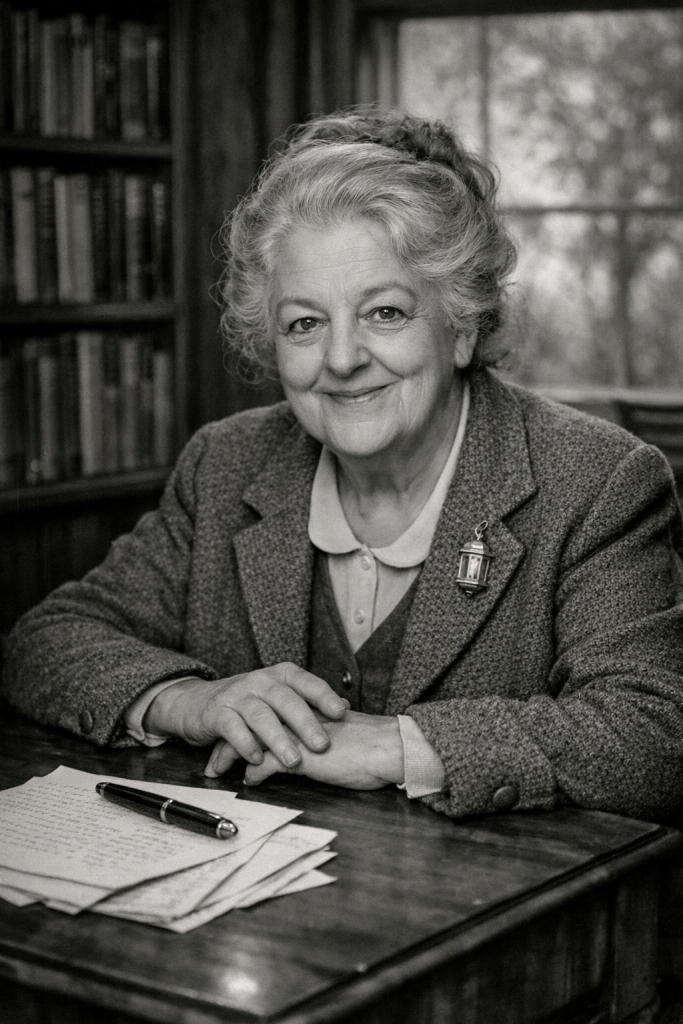
After the war ended she began a career as a writer and illustrator of children’s books. Her first book,The Lantern in the Lane (Larkwing, 1947) was a modest success, but was harshly treated by the critics. One national newspaper derided it as a “derivative pastiche of Enid Leadbeater”, a judgement that stung her deeply, and nearly caused her to abandon writing altogether.
The following year she had what she described as “the most magical and spiritually extraordinary moment of my life”. She never spoke of it in detail. But she attributed to it the inspiration for the book which would change her life forever—1948’s The Elf and the Orc. It tells the story of a “practically immortal” Elf who carries an ancient sorrow, and an Orc who feels he is the perpetual outcast; and how, after an accident on a lonely road brings them together, they build a life, a home and a future alongside one another.
Over the next forty years she produced more than a dozen titles in the series, all published with Larkwing Books, as well as half a dozen books aimed at younger children featuring Elf and Orc’s friends Lario and Kharul in a delightful series of adventures. All were marked by her characteristic blend of humour, kindness and quiet metaphysics.
Moore was appointed MBE in the 1978 New Year’s Honours for services to children’s literature. She returned the award in 1988 in protest against the passing into law of Section 28 of the Local Government Act, an infamous piece of legislation which made it illegal for local authorities in England, Scotland and Wales to “intentionally promote homosexuality or publish material with the intention of promoting homosexuality” or “promote the teaching in any maintained school of the acceptability of homosexuality as a pretended family relationship.”
For Moore, who was gay herself and had been appalled by the treatment of her friend and wartime colleague Alan Turing, this was nothing short of an attack on gay children. In a brief letter to the Cabinet Office returning her MBE she wrote:
“Stories teach children how to be brave; governments should not teach them how to be afraid … I cannot in all conscience continue to hold an award from a government which dresses up bigotry, hatred and cruelty as policy.”
Later that year she published her final book, The Cottage Beyond the Gate (1988). She described it as “the book she had been trying to write her whole life”. She went on,
“At last I have been able to show Elf and Orc as they truly are—not just best friends, but devoted partners in love as well as in life.”
The book, which ends with what one critic at the time called “the most perfect of all fairy-tale weddings”, was decried by self-appointed guardian of the nation’s morals, Mary Whitehouse, as “contemptible filth”, and it was banned from council-run libraries until 2003. But generations of queer children who had grown up with Elf and Orc, and who had seen something of themselves in Moore’s characters, were suddenly vindicated. Copies found their way onto library shelves despite the ban, sometimes slipped into borrowed dust-jackets, more often displayed quite openly by librarians who refused to be cowed.
James Merrin said of Cottage, “This is the most important book I have ever published, and the one of which I am most proud.”
Moore insisted that Elf and Orc and their friends were real. “As real as you and me,” she would tell children when they asked her.
She lived for many years in Ramsey, a historic market town in Cambridgeshire, in a small cottage which she shared with her partner of more than forty years, Agnes Hargreaves.
She died at home after a short illness in 1989, aged 76.
But her legacy lives on.
Bibliography of Margaret Moore
- The Lantern in the Lane (1947)
- The Elf and the Orc (1948)
- The Shape of His Name (1950)
- The Sunshine Boys (1952), in which she introduces Lyras and Melion
- At the Gates of Dawn (1954)
- Four Go Mad in Candax (1957)
- The Return of the Wanderer (1959), in which she introduces Lario
- Forgotten Tales of the Elder Folk (1960)
- The Doom of Carcossa (1962)
- A Song of the Sea (1965)
- The Electrician’s Apprentice (1970), in which she introduces Kharul. This book is sometimes called the first of the Lario & Kharul series, although it is aimed at the same age group as the Elf and Orc titles.
- What Breaks Boys (1972), the darkest of the series, in which she appears to kill off the character of Orc
- In the Nation That Is Not (1974), in which Orc is brought back to life
- The Cottage Beyond the Gate (1988), aimed at an older audience, in which the romantic nature of Elf and Orc’s relationship, long hinted at, is fully revealed.
In the Lario & Kharul Series:
- Lario & Kharul and the Secret of Smugglers’ Bottom (1973)
- Lario & Kharul and the Magic Talking Box (1975)
- Lario & Kharul and the Lantern of Lost Voices (1977)
- Lario & Kharul and the Witch Who Stole the Milk (1980)
- Lario & Kharul and the Clock That Wouldn’t Stop (1982)
- Lario & Kharul and the Moonlit Market (1984)