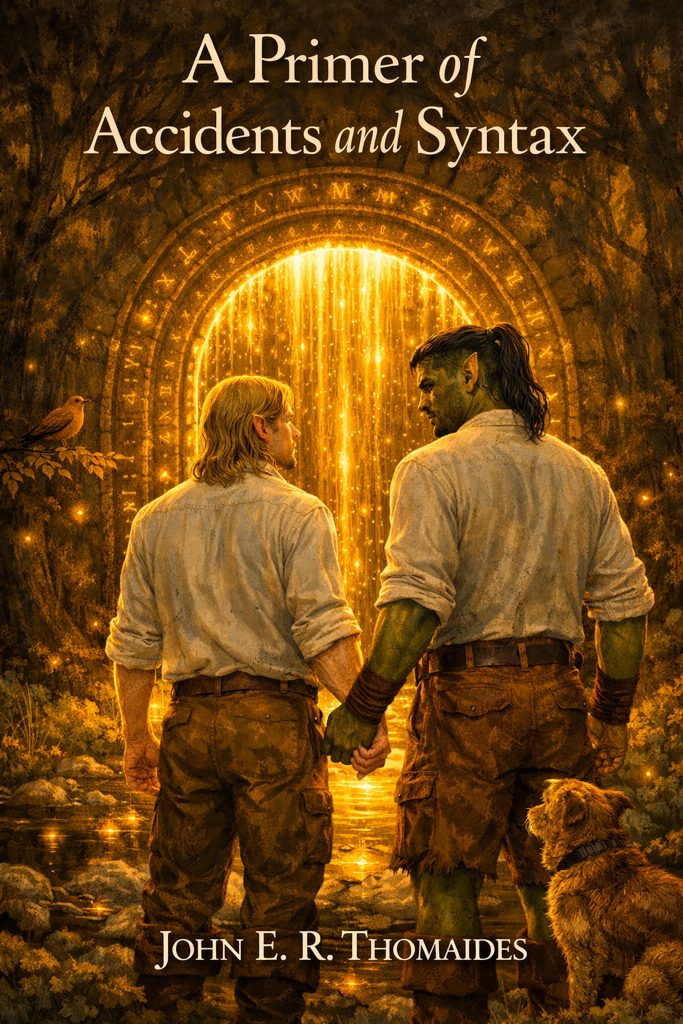
Elf is the bearer of an ancient trauma. Orc is searching for somewhere he feels he belongs. When an accident on a lonely road throws them together, they build a home, a life and a future beside one another.
But shadows are rising even in Arcadia. And when the darkness touches close to home, the two of them must confront what it means to stand together, not just in peace but in peril, and whether love alone can hold the centre.
Larkwing Books is delighted to announce the first novel from John E. R. Thomaides—a re-imagining for adult readers that honours and deepens the world Margaret Moore created.
C.E.O. Jamie Ferrante-Merrin said, “For years, readers have cherished Margaret Moore’s characters. This is the first time we’ve entrusted them to a new story-teller—and John sees them with the same heart she did.”
A Primer of Accidents and Syntax will be published on 17 September 2026, available in hardback, paperback, and on Kindle, exclusively from Amazon.
Surely the most unforeseen development of the mid 2010s was the “Hot Melion” phenomenon.
Rumours of a lost page of the “Elf of Finland” calendar—the July plate, supposedly featuring a buff version of Melion wearing only an apple—began circulating online in 2013, giving rise to the meme “Hot Melion”.
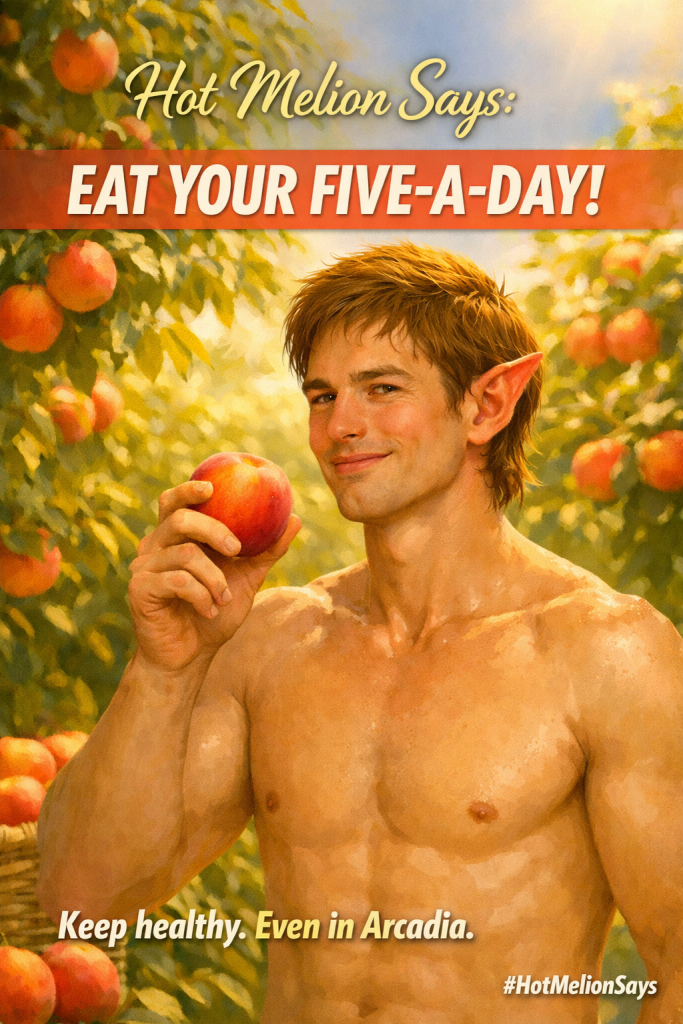
“Hot Melion” would doubtless have sunk into internet obscurity had not the UK’s National Health Service run an official public-health poster campaign using the tagline Hot Melion Says: Wear Sunscreen, quickly followed by Hot Melion Says: Keep Hydrated and Hot Melion Says: Eat Your Five-a-Day. For one surreal summer, Hot Melion was everywhere: on the sides of buses, on the London Underground, even on the big screen in Piccadilly Circus.
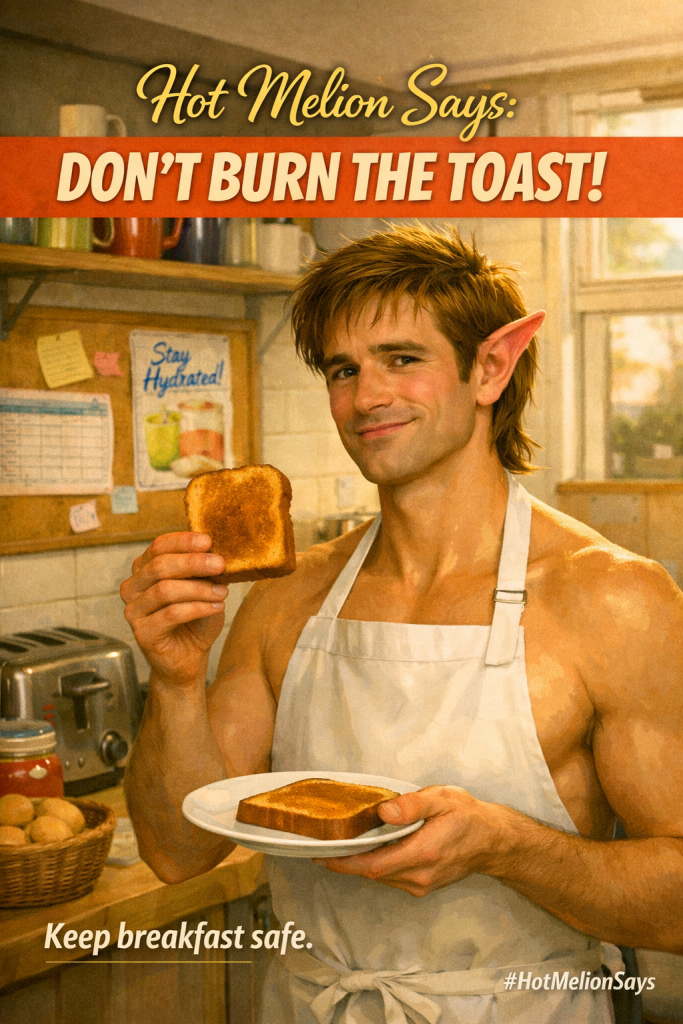
Student parodies quickly circulated, most badly drawn or badly photoshopped. But one, Hot Melion Says: Don’t Burn the Toast surpassed them all, featuring high-quality original artwork of Hot Melion, now in a chef’s apron, standing in a student kitchen and brandishing a plate of breakfast.
“Although you can tell that the Hot Melion in the Toast poster is clearly different from the one in the official NHS campaign, it quickly became the inspiration for a new set of parodies,” says Dr Paola Aspinetti, a Senior Lecturer in the History of the Internet at Cambridge University.
“Hot Melion Says: Chocolate Is A Fruit is typical: the piece of toast Hot Melion holds is replaced by a bar of chocolate, and his other arm, holding the plate, is simply airbrushed out. But the homage has a charm of its own.”
As with all internet fads, the craze soon fizzled out.
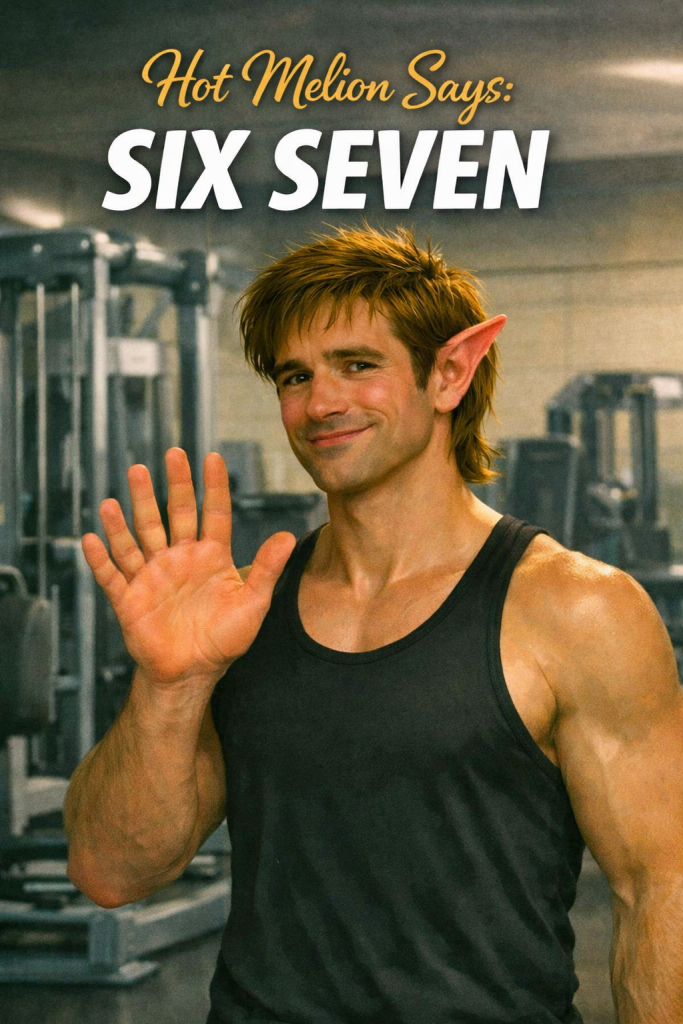
But then in 2025 Hot Melion made a brief comeback in an AI-generated image titled Hot Melion Says Six Seven, this time wearing a black muscle top and standing, somewhat inexplicably, in a gym.
“Typical of early AI images,” says Dr Aspinetti, “if you look carefully, Hot Melion has six fingers on his right hand.”
We don’t know what Melion would say if he discovered that he’d briefly become a queer icon, but we imagine he would be secretly delighted.
Melion, Meme and Melancholy: The Semiotics of Fruit in the Digital Landscape, by Dr Paola Aspinetti, is published by Arkham University Press.
Donation to benefit Lantern Youth Trust and the Fondazione Brunone Salvi
SAFFRON WALDEN, 14 May 2024—Larkwing Books today announced the resolution of its longstanding copyright dispute with SiQuill Studios regarding the unauthorised use of characters and imagery from the Elf and Orc books.
The matter has been settled amicably. As part of the agreement, SiQuill Studios has made a sizeable charitable donation, divided equally between The Lantern Youth Trust and the newly established Fondazione Brunone Salvi.
The Lantern Youth Trust, founded in 1984 and patronised by author Margaret Moore until her death in 1989, provides vital support to LGBTQ+ teenagers across the UK, offering crisis housing, mentorship programmes, arts grants, and mental health services. The donation will expand the Trust’s outreach initiatives and fund new creative writing bursaries in Moore’s name.
The Fondazione Brunone Salvi was established in 2024 to honour the late Italian actor Brunone Salvi, whose portrayal of Orc in the 1974 film L’Elfo e il Compagno Orco remains beloved by fans worldwide. The foundation supports individuals living with HIV/AIDS in Rome and the Lazio region, providing medical assistance, community outreach, and dignity-centred care.
Salvi corresponded with Margaret Moore for many years, and his death in 1987 deeply affected her. The creation of the foundation reflects Moore’s long-standing commitment to compassion and the welfare of vulnerable communities.
Statement from Larkwing Books CEO, Jamie Ferrante-Merrin
We are grateful to SiQuill Studios for their cooperation and for recognising the importance of supporting the communities closest to Margaret Moore’s legacy. The Lantern Youth Trust and the Fondazione Brunone Salvu embody the values she championed throughout her life: kindness, courage, and care for those who need it most.
The settlement concludes all legal proceedings. Larkwing Books extends its thanks to Alex Westwood of Silver, Starr & Westwood, who represented the company pro bono publico.
For further information please contact the Larkwing Books Communications Office.
We recently discovered an episode of Film ’74 which reviewed the film L’Elfo e il Compagno Orco. Here is a transcript of the segment.
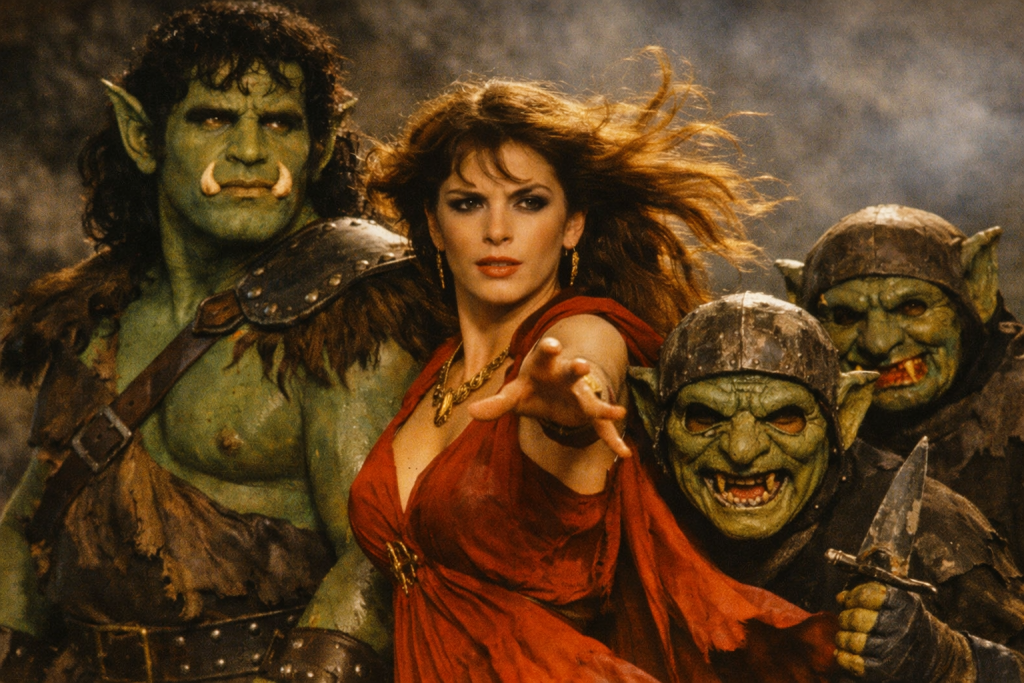
A still from the 1974 film L’Elfo e il Compagno Orco. Brunone Salvi as Orc, Lucia Manfredi as Lady Sefira, and two of her goblinetti.
“Well now… every so often a film comes along that defies easy description. Not because it’s particularly complex, you understand, but because it’s so gloriously, bewilderingly earnest.”
This week, from Italy, we have L’Elfo e il Compagno Orco, a fantasy adventure made on what appears to be the sort of budget normally reserved for school plays. There’s a castle, there’s a magic sword, there’s a sorceress in a red dress (Lucia Manfredi) who seems to be fighting both goblins and her own wind machine — and in the middle of it all, there are two young men giving performances of surprising sincerity.
Giorgio Riva plays the Elf, all golden hair and soulful glances, while Brunone Salvi — painted an impressive shade of green — plays the Orc. And here’s the thing: against all odds, they’re rather good. The relationship between the two is the film’s beating heart, and it’s handled with a tenderness that feels quite out of place in a production otherwise held together by string, glue, and sheer optimism.
The plot, such as it is, involves a glowing sword, a burning castle, and an army of goblins who look as though they’ve escaped from a children’s Christmas panto. Paolo Seri strides about heroically as a knight who thinks he’s the protagonist, though the film itself seems far more interested in the Elf and his devoted companion.
“It’s all very silly, of course — but there’s a charm to it. A sort of wide‑eyed innocence you don’t often see, even in fantasy films.”
The direction by Gianni Vellani is enthusiastic if not always coherent, and the special effects are… well, let’s say they’re special in spirit rather than execution. But Ennio Fabriss’s score does its best to convince us we’re watching an epic, and occasionally succeeds.
What lingers, though, is the unexpected emotional weight. Riva and Salvi bring a genuine warmth to their scenes together, and you find yourself caring about them far more than the film’s modest ambitions deserve.
“Not a great film, not even a particularly good one — but oddly touching. And sometimes, that’s enough.”
A Larkwing Books tribute to Brunone “L’Orco” Salvi
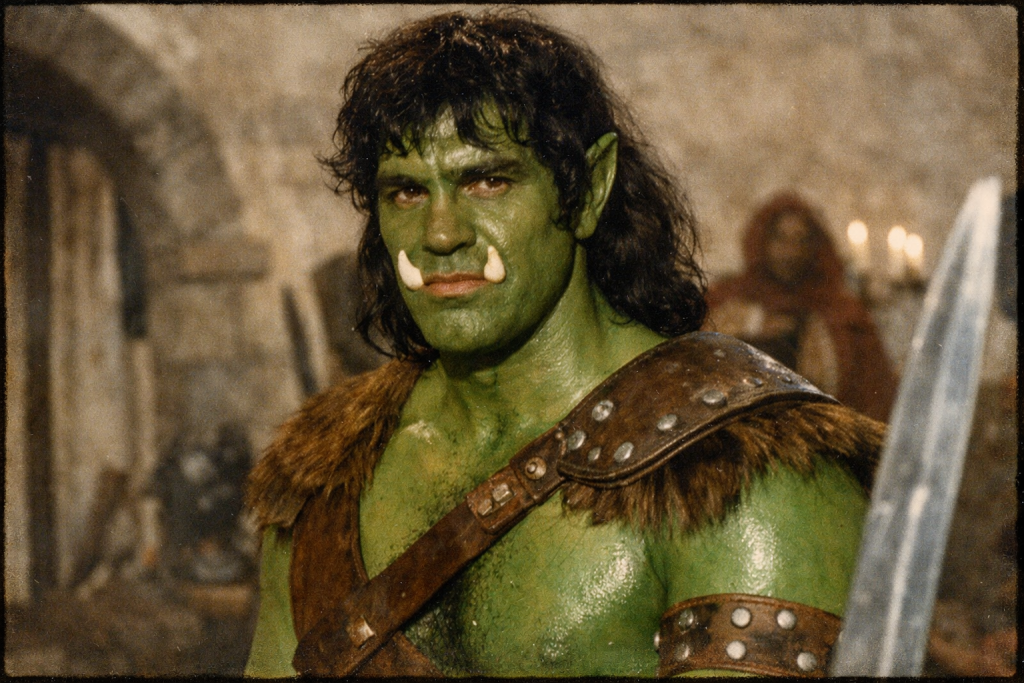
Brunone Salvi as Orc in L’Elfo e il Compagno Orco (1974).
There are stories that shape childhoods, and then there are stories that shape cultures. For many Italians from the 1970s onwards, L’Elfo e il Compagno Orco was both. Long before streaming, long before fantasy became mainstream, long before anyone spoke of “queer readings”, an Italian studio produced a film so earnest, so improbable, and so unexpectedly tender that it became a quiet legend.
At its centre was a man painted green.
His name was Brunone Salvi—known professionally and later in the wrestling ring as L’Orco. This is his story.
Brunone Salvi è L’Orco!
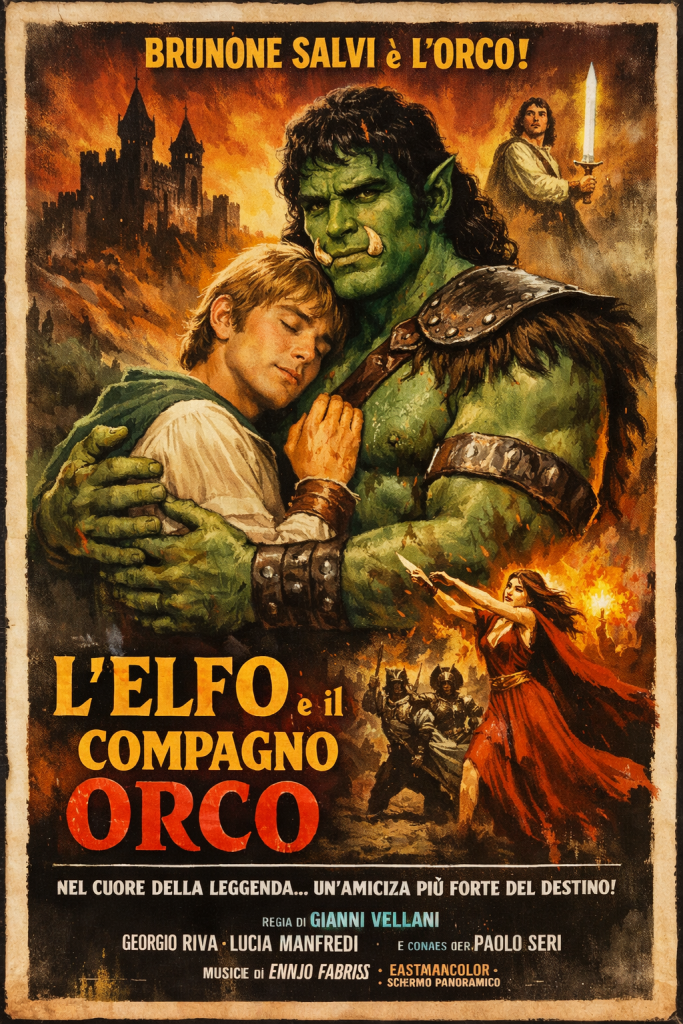
Released in 1974 and shown on television every New Year’s Day since 1980, L’Elfo e il Compagno Orco was directed by Gianni Velliani, a man who believed passionately in mythic melodrama and even more passionately in filming at dawn. The budget was small. The ambition was enormous. The paint was applied with sponges.
Movie poster for L’Elfo e il Compagno Orco (1974)
Brunone Salvi, a 25-year-old lifeguard and amateur bodybuilder from Ostia, was cast as the Orc because he was huge, gentle, available, and willing to be painted green.
Never having learned to read or write, he memorised his lines by rote. He delivered them with absolute sincerity. And he created one of the most unexpectedly moving performances in Italian fantasy cinema.
His most famous line—meant to be the heroic Io proteggerò l’Elfo!—emerged, after many takes, as the broken but unforgettable:
“Io … proteggere … Elfo.”
It shouldn’t have worked.
It did.
It became iconic.
L’ Ulko mancato
In 1977, Brunone was flown to Los Angeles to audition for a new syndicated television series about another heroic green giant. He was painted once more in his signature colour. He lifted a car bumper. He smiled too much. He was told, politely, that the producers wanted an actor with a “family man” image.
Brunone was unmarried.
An unknown actor from New York got the role.
La Voce di Roma ran the headline Brunone Salvi: il nostro Ulko mancato!
L’Orco fa slam!
After returning to Italy, Brunone reinvented himself as a professional wrestler. Under the ring name L’Orco, he performed in regional circuits throughout the late ’70s and early ’80s, wearing his famous green body paint (now fluorescent), a repurposed leather pauldron from his movie costume, and stick-on tusks now made of rubber so as not to gouge his opponents. He entered to music recycled from the film score, and announced his signature move with the catchphrase L’Orco fa slam!
Crowds adored him. Children asked for autographs. Adults shouted the line Io … proteggere … Elfo!
Always a “face” character, he refused point blank to play a villainous “heel”. He bowed before every match.
The Quiet Years
By the mind-1980s, Brunone retired and opened a small gym in his home town of Ostia. He trained young athletes, kept a faded poster of the film on the wall, and occasionally appeared at fantasy conventions where fans brought VHS tapes for him to sign.
He died in 1987 in the Ospedale dei Poveri in Rome.
The official cause of death was pneumonia.
He was thirty-eight.
Why We Remember Him
Brunone Salvi embodied something rare: a myth made human.
He wasn’t a star. He wasn’t a celebrity. He wasn’t even a trained actor.
He was a gentle man who stepped into a story and carried it—literally—with his whole body. He gave the Orc a soul. He gave Italian audiences a hero who didn’t need perfect grammar to express devotion. And he gave one Sicilian boy—years later— the sense that compagno meant destiny.
That boy grew up to be Elio Ferrante. And when he met Jamie Merrin on a beach in Cefalù, he recognised the moment because Brunone Salvi had taught him how.
A Legacy Painted Green
“People still ask me about that movie,” says Brunone’s co-star, Georgio Riva. “The laugh about the paint, the costumes, the melodrama. I let them laugh. They don’t understand what it was like to be twenty-three and to meet someone like Brunone.”
“He was … luminous. Not in the way actors are. He didn’t care about fame, or technique, or any of the things I thought mattered. He cared about the story. He cared about me. And I was too young to know what to do with that. But when he said Io … proteggere … Elfo, I believed him.”
“When he died … it broke my heart. It breaks my heart that he was taken from us that way, that he died alone in that dreadful place. Brunone deserved better. He deserved a long life. He deserves to be remembered.”
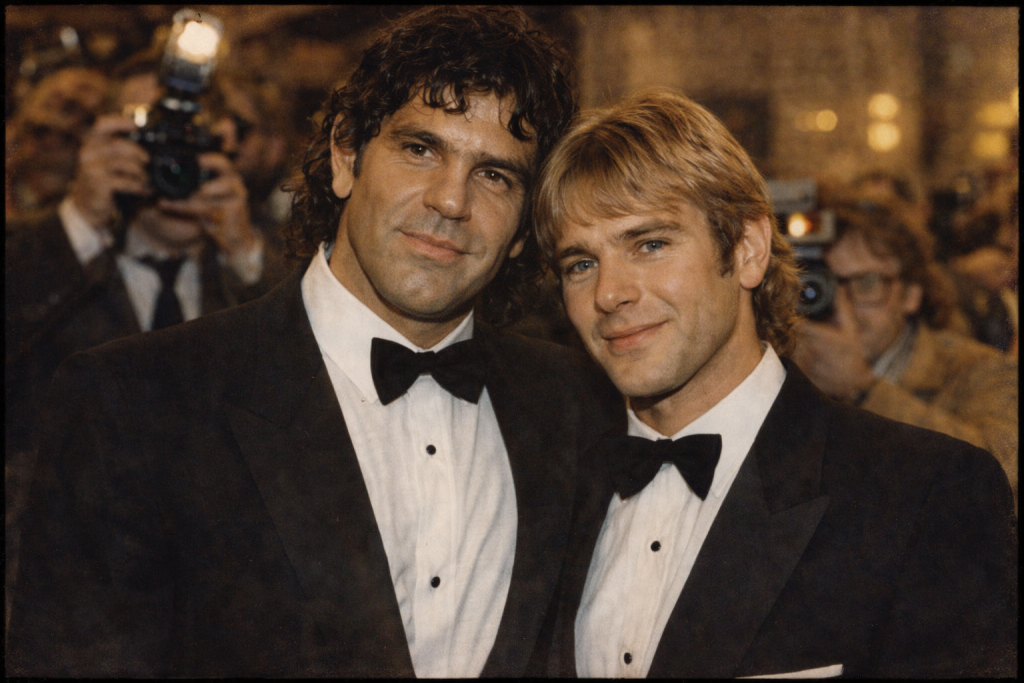
“Sometimes people ask if we were in love. I can say now: of course we were.” Brunone Salvi (left) and Georgio Riva, who portrayed Elf, at the premier of L’Elfo e il Compagno Orco, Rome, 1974.
Today, as Larkwing continues to explore the cultural history of The Elf and the Orc, we honour Brunone Salvi—the gentle green giant of Italian cinema—whose imperfect line became a perfect declaration.
His story reminds us that myth is made not only by writers and directors, but by the people who step into the paint, lift the sword, and say the words as best they can.
Even when the words come out broken.
Even when the world doesn’t notice.
Even when the legend is carried quietly, for decades, in the hearts of those who grew up watching him.
“Sometimes people ask if we were in love,” says Riva. “I can say now: of course we were.”
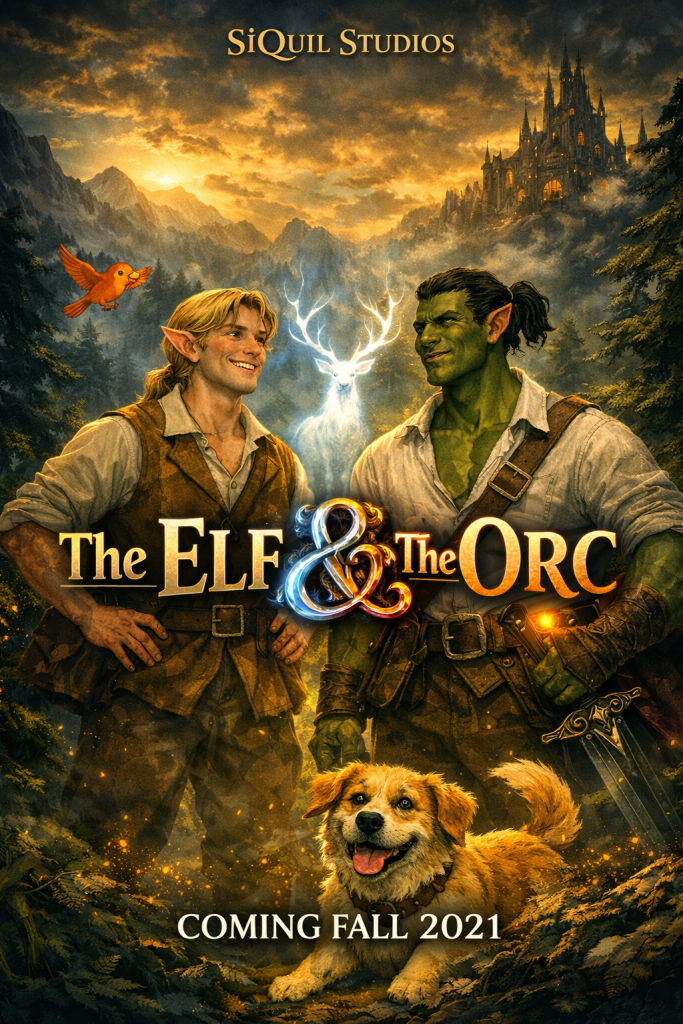
Several devoted readers of Margaret Moore’s Elf and Orc books have written to ask about the upcoming movie The Elf and the Orc from SiQuill Studios.
The movie is not endorsed by Larkwing Books, and we have had no part in its development. The characters of Elf, Dog, Bird, Stag, and a horribly re-imagined Orc have been used without permission.
We would like to address a few specific concerns that have been raised:
The Orc redesign
SiQuill’s Orc has been radically altered. Instead of the quiet, gentle, steadfast companion Margaret Moore created, the studio has produced a towering, heavily muscled creature with exaggerated proportions, unrecognisable facial features, and a permanently comic expression. This “buffer Orc” bears no resemblance to the character readers know—either in appearance or in spirit.
The removal of the central relationship
The emotional heart of the books—the bond between Elf and Orc—has been removed entirely. In its place the film presents a conventional “hero and comic sidekick” dynamic, with none of the depth, loyalty or tenderness that defines Moore’s work. We understand this has been upsetting for long-term readers, and we share your concerns.
Characterisation of Elf
Elf has been rewritten as a wisecracking New Yorker, delivering contemporary one-liners and pop-culture references. This is a complete departure from Moore’s Elf, whose voice is shaped by grief, beauty, and the slow, careful unfolding of trust. The studio’s version is simply not Elf.
Characterisation of Orc
Orc has been transformed into a large, bumbling, broadly comic figure whose mannerisms and dialogue strongly resemble certain well-known animated ogres of the early 2000s—minus the charm, and minus the dignity. This portrayal is entirely at odds with Moore’s Orc, whose quiet strength and devotion are central to the books.
What are we doing about it?
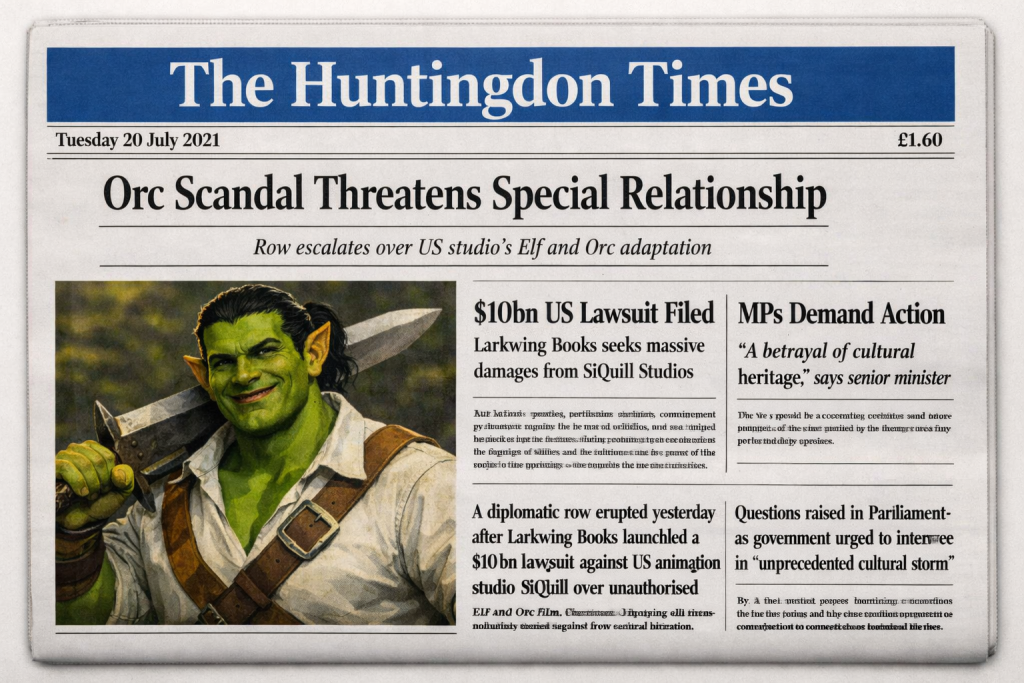
Larkwing Books remains committed to protecting Margaret Moore’s legacy. We have engaged legal representation from the firm of Silver, Starr & Westwood, and have launched proceedings to sue SiQuill Studios for the sum of US$10bn.
The strength of public feeling is such that questions have been asked in the House of Commons, and the Department of Culture, Media and Sport has raised the issue with the Office of the US President.
We are grateful to readers who have written to us, and we will continue to keep you informed as matters develop.