
Rediscovering L’Elfo e il Compagno Orco
A Larkwing Books tribute to Brunone “L’Orco” Salvi
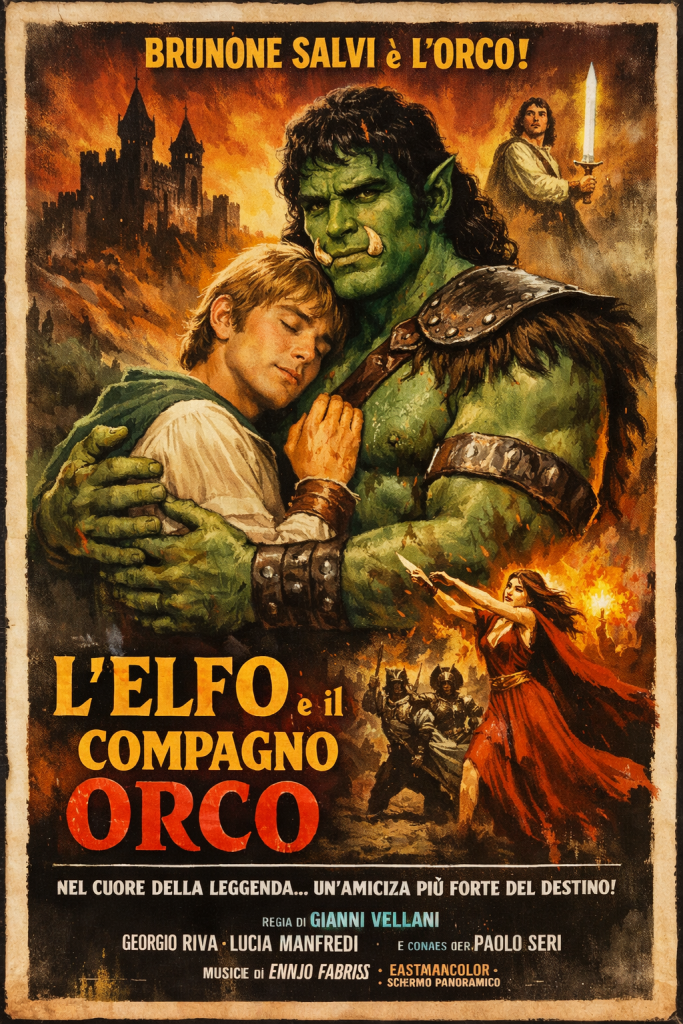
There are stories that shape childhoods, and then there are stories that shape cultures. For many Italians from the 1970s onwards, L’Elfo e il Compagno Orco was both. Long before streaming, long before fantasy became mainstream, long before anyone spoke of “queer readings”, an Italian studio produced a film so earnest, so improbable, and so unexpectedly tender that it became a quiet legend.
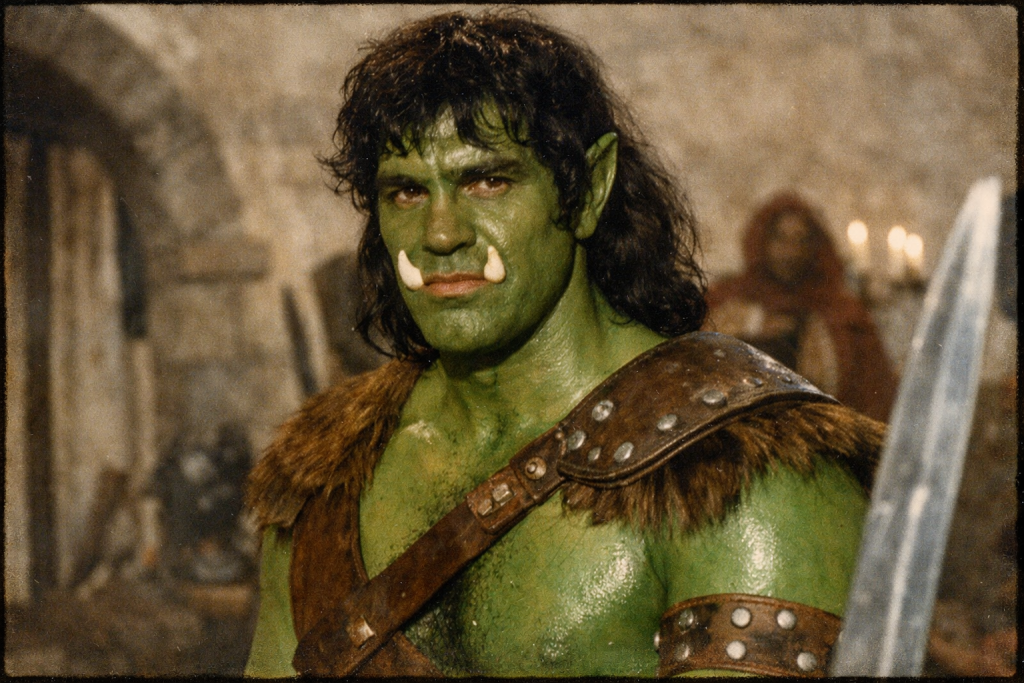
At its centre was a man painted green.
His name was Brunone Salvi—known professionally and later in the wrestling ring as L’Orco. This is his story.
Brunone Salvi è L’Orco!
Released in 1974 and shown on television every New Year’s Day since 1980, L’Elfo e il Compagno Orco was directed by Gianni Velliani, a man who believed passionately in mythic melodrama and even more passionately in filming at dawn. The budget was small. The ambition was enormous. The paint was applied with sponges.
Brunone Salvi, a 25-year-old lifeguard and amateur bodybuilder from Ostia, was cast as the Orc because he was huge, gentle, available, and willing to be painted green.
Never having learned to read or write, he memorised his lines by rote. He delivered them with absolute sincerity. And he created one of the most unexpectedly moving performances in Italian fantasy cinema.
His most famous line—meant to be the heroic Io proteggerò l’Elfo!—emerged, after many takes, as the broken but unforgettable:
“Io … proteggere … Elfo.”
It shouldn’t have worked.
It did.
It became iconic.
L’ Ulko mancato
In 1977, Brunone was flown to Los Angeles to audition for a new syndicated television series about another heroic green giant. He was painted once more in his signature colour. He lifted a car bumper. He smiled too much. He was told, politely, that the producers wanted an actor with a “family man” image.
Brunone was unmarried.
An unknown actor from New York got the role.
La Voce di Roma ran the headline Brunone Salvi: il nostro Ulko mancato!
L’Orco fa slam!
After returning to Italy, Brunone reinvented himself as a professional wrestler. Under the ring name L’Orco, he performed in regional circuits throughout the late ’70s and early ’80s, wearing his famous green body paint (now fluorescent), a repurposed leather pauldron from his movie costume, and stick-on tusks now made of rubber so as not to gouge his opponents. He entered to music recycled from the film score, and announced his signature move with the catchphrase L’Orco fa slam!
Crowds adored him. Children asked for autographs. Adults shouted the line Io … proteggere … Elfo!
Always a “face” character, he refused point blank to play a villainous “heel”. He bowed before every match.
The Quiet Years
By the mind-1980s, Brunone retired and opened a small gym in his home town of Ostia. He trained young athletes, kept a faded poster of the film on the wall, and occasionally appeared at fantasy conventions where fans brought VHS tapes for him to sign.
He died in 1987 in the Ospedale dei Poveri in Rome.
The official cause of death was pneumonia.
He was thirty-eight.
Why We Remember Him
Brunone Salvi embodied something rare: a myth made human.
He wasn’t a star. He wasn’t a celebrity. He wasn’t even a trained actor.
He was a gentle man who stepped into a story and carried it—literally—with his whole body. He gave the Orc a soul. He gave Italian audiences a hero who didn’t need perfect grammar to express devotion. And he gave one Sicilian boy—years later— the sense that compagno meant destiny.
That boy grew up to be Elio Ferrante. And when he met Jamie Merrin on a beach in Cefalù, he recognised the moment because Brunone Salvi had taught him how.
A Legacy Painted Green
“People still ask me about that movie,” says Brunone’s co-star, Georgio Riva. “The laugh about the paint, the costumes, the melodrama. I let them laugh. They don’t understand what it was like to be twenty-three and to meet someone like Brunone.”
“He was … luminous. Not in the way actors are. He didn’t care about fame, or technique, or any of the things I thought mattered. He cared about the story. He cared about me. And I was too young to know what to do with that. But when he said Io … proteggere … Elfo, I believed him.”
“When he died … it broke my heart. It breaks my heart that he was taken from us that way, that he died alone in that dreadful place. Brunone deserved better. He deserved a long life. He deserves to be remembered.”
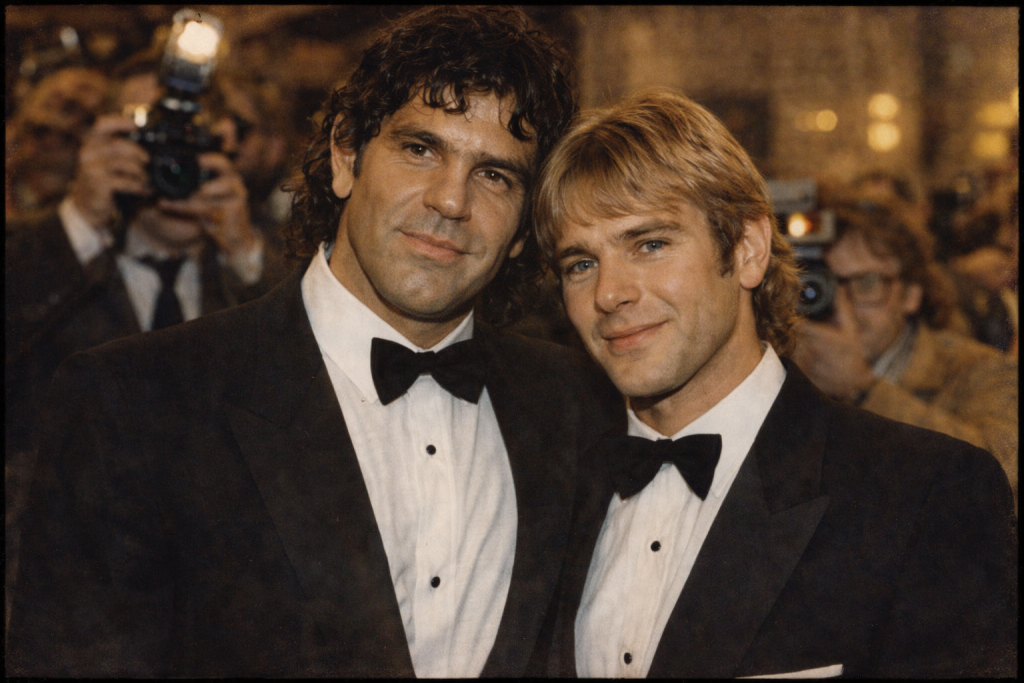
Brunone Salvi (left) and Georgio Riva, who portrayed Elf, at the premier of L’Elfo e il Compagno Orco, Rome, 1974.
Today, as Larkwing continues to explore the cultural history of The Elf and the Orc, we honour Brunone Salvi—the gentle green giant of Italian cinema—whose imperfect line became a perfect declaration.
His story reminds us that myth is made not only by writers and directors, but by the people who step into the paint, lift the sword, and say the words as best they can.
Even when the words come out broken.
Even when the world doesn’t notice.
Even when the legend is carried quietly, for decades, in the hearts of those who grew up watching him.
“Sometimes people ask if we were in love,” says Riva. “I can say now: of course we were.”
Thank you, Brunone Salvi.
And may flights of angels hymn thee to thy rest.