Category: Uncategorized

  • L’Elfo e il Compagno Orco review

    We recently discovered an episode of Film ’74 which reviewed the film L’Elfo e il Compagno Orco. Here is a transcript of the segment.
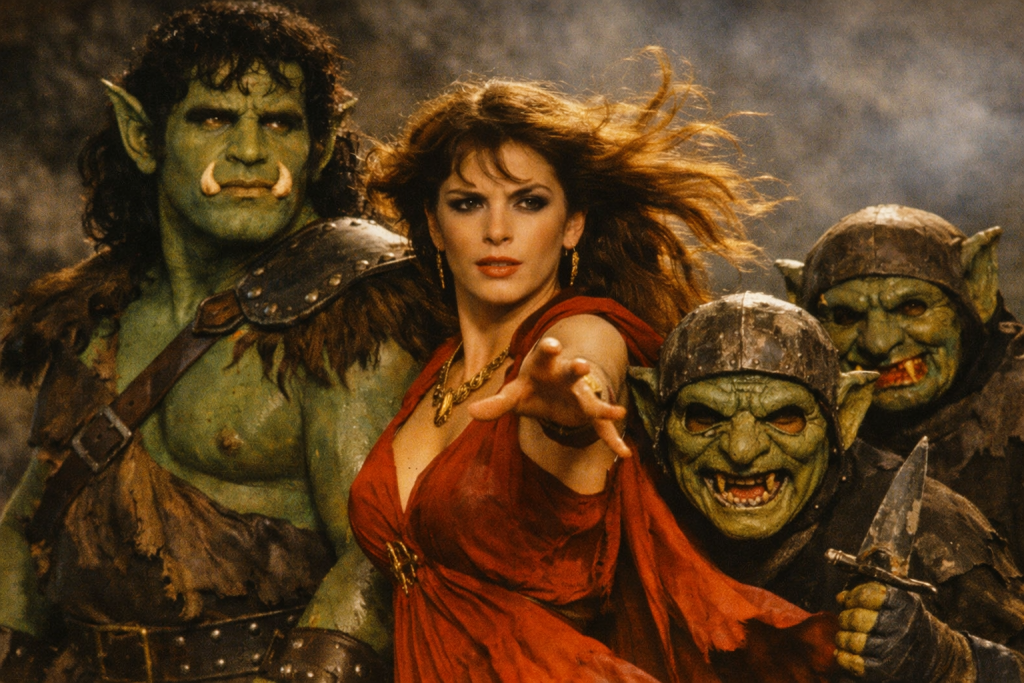
    A still from the 1974 film L’Elfo e il Compagno Orco. Brunone Salvi as Orc, Lucia Manfredi as Lady Sefira, and two of her goblinetti.

    “Well now… every so often a film comes along that defies easy description. Not because it’s particularly complex, you understand, but because it’s so gloriously, bewilderingly earnest.”

    This week, from Italy, we have L’Elfo e il Compagno Orco, a fantasy adventure made on what appears to be the sort of budget normally reserved for school plays. There’s a castle, there’s a magic sword, there’s a sorceress in a red dress (Lucia Manfredi) who seems to be fighting both goblins and her own wind machine — and in the middle of it all, there are two young men giving performances of surprising sincerity.

    Giorgio Riva plays the Elf, all golden hair and soulful glances, while Brunone Salvi — painted an impressive shade of green — plays the Orc. And here’s the thing: against all odds, they’re rather good. The relationship between the two is the film’s beating heart, and it’s handled with a tenderness that feels quite out of place in a production otherwise held together by string, glue, and sheer optimism.

    The plot, such as it is, involves a glowing sword, a burning castle, and an army of goblins who look as though they’ve escaped from a children’s Christmas panto. Paolo Seri strides about heroically as a knight who thinks he’s the protagonist, though the film itself seems far more interested in the Elf and his devoted companion.

    “It’s all very silly, of course — but there’s a charm to it. A sort of wide‑eyed innocence you don’t often see, even in fantasy films.”

    The direction by Gianni Vellani is enthusiastic if not always coherent, and the special effects are… well, let’s say they’re special in spirit rather than execution. But Ennio Fabriss’s score does its best to convince us we’re watching an epic, and occasionally succeeds.

    What lingers, though, is the unexpected emotional weight. Riva and Salvi bring a genuine warmth to their scenes together, and you find yourself caring about them far more than the film’s modest ambitions deserve.

    “Not a great film, not even a particularly good one — but oddly touching. And sometimes, that’s enough.”
  • The “Elf of Finland” Calendar

    There have been all sorts of Elf and Orc spin-off media, some official, some created by you, the dedicated readers. But none is more bizarre than the 1978 calendar illustrated by an artist using the pseudonym “Elf of Finland”.

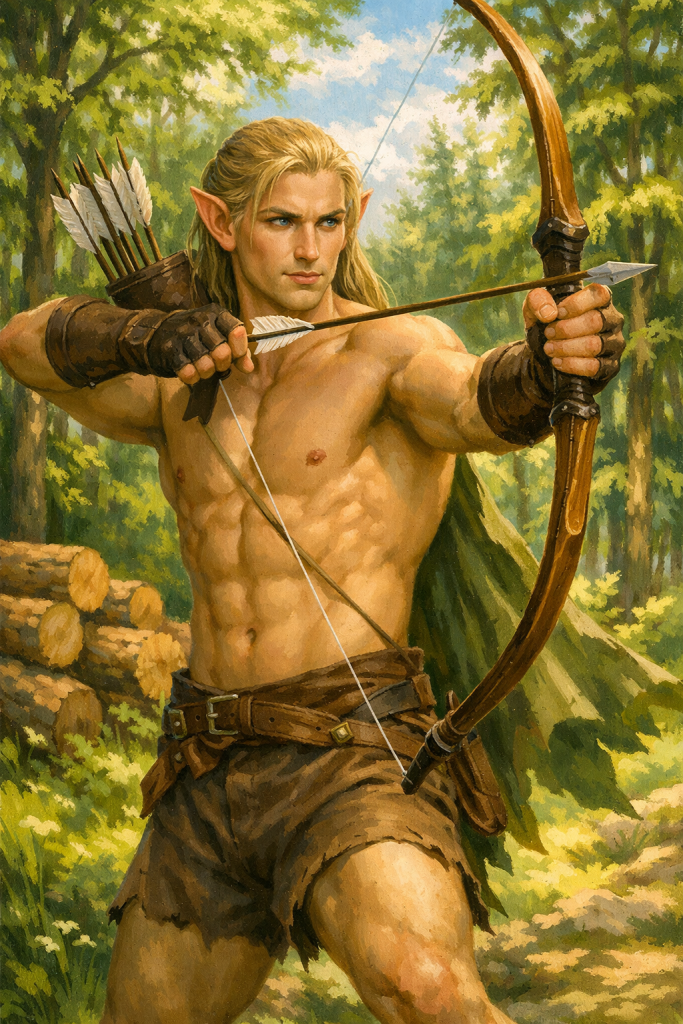
    "The Arrows of Desire" page. July from the "Elf of Finland" calendar (1978).
    The Arrows of Desire (Janurary from the 1978 “Elf of Finland” calendar)

    Ostensibly a “tribute” to Margaret Moore’s Elf and Orc novels, it was in practice something quite different: twelve lavishly illustrated plates depicting the beloved characters in a kind of hyper-stylised, idealised masculinity, familiar to anyone who knows the more adventurous corners of mid-century illustration. Today it looks all very tame. In 1978 it would have been scandalous.

    Each month offered a diffetent tableau: Elf, Orc and their friends rendered as gleaming paragons of muscle and myth, their poses heroic to the point of parody. The art style drew on a Northern European sensibility—crisp lines, leather and light—that transformed Moore’s gentle pastoral fantasy into a fantasy of an altogether different kind.

    The tone was unabashedly homoerotic—January, entitled The Arrows of Desire, for example, with Elf bare-chested in cut-off leather shorts about to shoot an arrow.

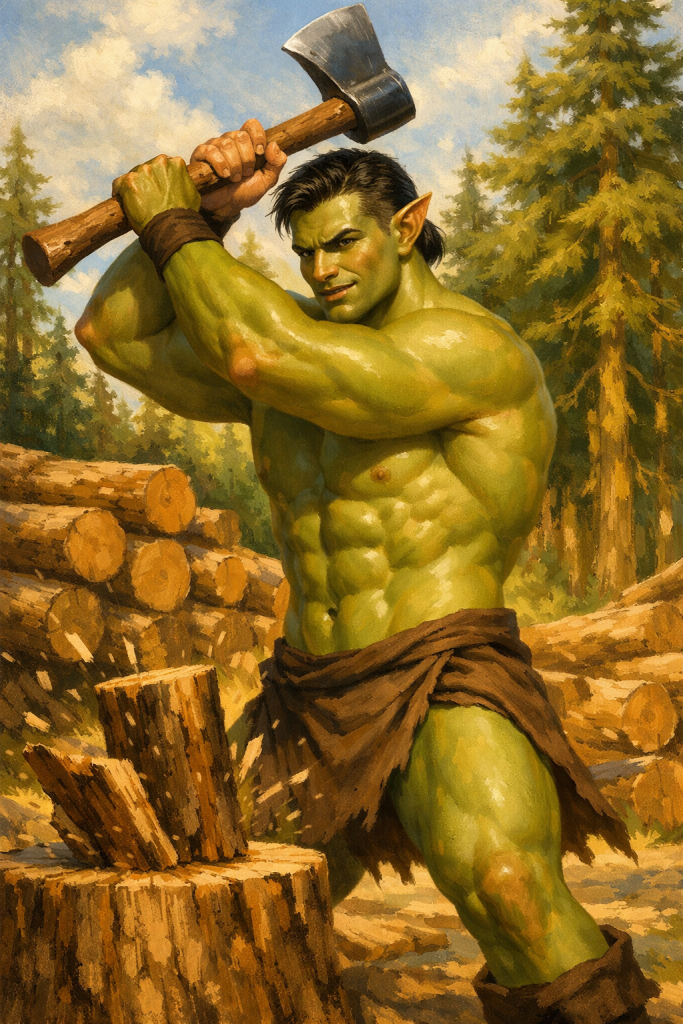
    At the Wood Pile, a.k.a. Orc’s Chopper (March from the 1978 “Elf of Finland” calendar.

    Few of the plates now survive. A poster based on March—officially titled At the Wood Pile but commonly known as Orc’s Chopper—was available from a well-known high-street stationer in the 1990s. It featured Orc in a lumberjack setting, axe raised, muscles exaggerated to mythic proportions, and wearing a loin cloth that was most certainly not up to the task required of it.

    July—The Apple of His Eye—is the most mysterious of all. The plate is rumoured to have featured a heavily-muscled Melion, posed in the orchard, wearing nothing but a strategically-placed piece of fruit—an apple in some tellings, a pear in others. No copies of this print are known to exist.

    According to long-standing rumours, in the early 1990s a mysterious collector known only as “L.” tracked down and purchased all surviving copies, thus removing them from circulation.

    But the possibly-mythical July page almost certainly gave rise to the Hot Melion phenomenon of the mid 2010s—a wave of affectionate, tongue-in-cheek fan art, and an official UK government public health poster campaign, celebrating Melion’s unexpected status as a queer icon.

  • How The Elf and the Orc brought us together

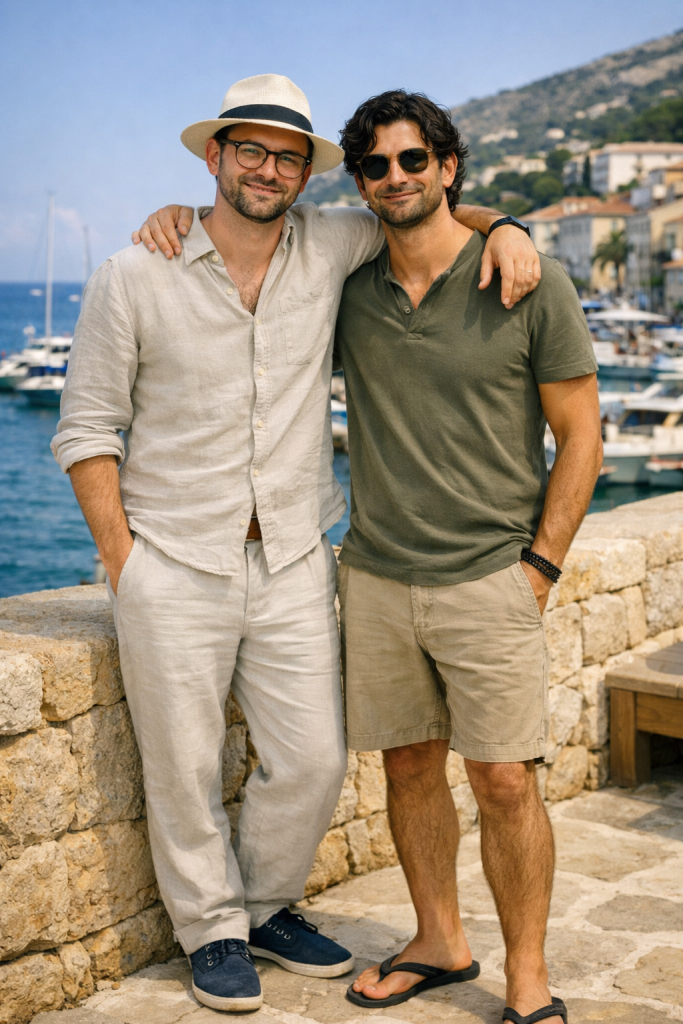
    Jamie and Elio Ferrante-Merrin

    Elio’s Story

    I grew up in Sicily, in a house full of sun and books. One of those books was L’Elfo e il Compagno Orco — the Italian edition of The Elf and the Orc. I didn’t know it was a translation. I didn’t know the English title was different. I didn’t know there was ever any doubt about the nature of their relationship.

    In Italian, compagno means someone you belong with. Not a friend. Not a playmate. A partner.

    So to me, Elf and Orc were a pair. A destined pair. A story written in two voices.

    Years later, on a hot afternoon in Cefalù, I came out of the sea and went to buy a granita. At the kiosk, a sunburnt Englishman was apologising to the owner while trying to order “the lemon ice thing.” I corrected him — kindly, I thought — and he turned to me with a shy, bookish smile that made my heart tilt.

    We talked. He told me his name: Jamie. He told me he worked in publishing. He told me his family ran a small press called Larkwing Books.

    I froze.

    Because Larkwing Books printed my book. My childhood book. My compagno book.

    I stepped closer and said, “I grew up with one of your titles. L’Elfo e il Compagno Orco.

    Jamie laughed, delighted. “In English it’s just The Elf and the Orc. People always argued about whether they were—”

    I interrupted him gently.

    “There was never any argument.”

    He blinked. “Oh?”

    “In Italian,” I said, “compagno means someone you belong with.”

    And in that moment — with the sea bright behind us and the granita melting in its cup — I knew exactly what the story was doing.

    It was continuing.

    Jamie’s Story

    I was sixteen when I came out. It wasn’t dramatic. It wasn’t planned. It wasn’t even particularly brave. It was just a quiet evening in our kitchen, my mum making tea, me holding a book I’d just finished: The Cottage Beyond the Gate.

    I’d read the last chapter twice. Then a third time. Then I walked downstairs, heart hammering, and said:

    “Mum… I think I’m like Orc.”

    She didn’t laugh. She didn’t look confused. She didn’t ask what I meant.

    She just put the kettle down, came over, and hugged me. And that was it. That was my coming out.

    So The Elf and the Orc has always been more than a book to me. It was the first story that made me feel seen — even before I understood why. And when Margaret Moore’s final volume revealed the truth Elf and Orc had carried all along, it felt like a door opening.

    Years later, I found myself in Cefalù, sunburnt and tired and trying to order a granita in Italian. I was failing in the most English way possible when a voice beside me said:

    “È più facile se dici ‘una granita al limone’.”

    I turned.

    And there he was — a man with wet hair, sun‑warmed skin, and a smile that made me forget every word of Italian I’d ever learned. He helped me order. We talked. His name was Elio.

    I told him I worked in publishing. I told him my family ran Larkwing Books. I told him he probably hadn’t heard of it.

    He went still — attentive, bright, like a door opening.

    “I know Larkwing,” he said. “I grew up with one of your books.”

    My heart did something strange.

    “Really? Which one?”

    He stepped closer. Salt and lemon and sunlight.

    L’Elfo e il Compagno Orco.

    I laughed. “That’s a lovely title. In English it’s just The Elf and the Orc. People always argued about whether they were—”

    He stopped me with a look so gentle it felt like a hand on my shoulder.

    “There was never any argument.”

    I blinked. “Oh?”

    “In Italian,” he said, “compagno means someone you belong with.”

    And something inside me shifted — a compass needle swinging toward north.

    Belong with.

    I looked at him — really looked — and realised he wasn’t telling me about a book. He was telling me about us. About the moment we were standing in. About the story that had just begun.

    The sea was bright. The air was warm. The granita melted in its cup.

    And I thought:

    So this is how a book brings two people together.