
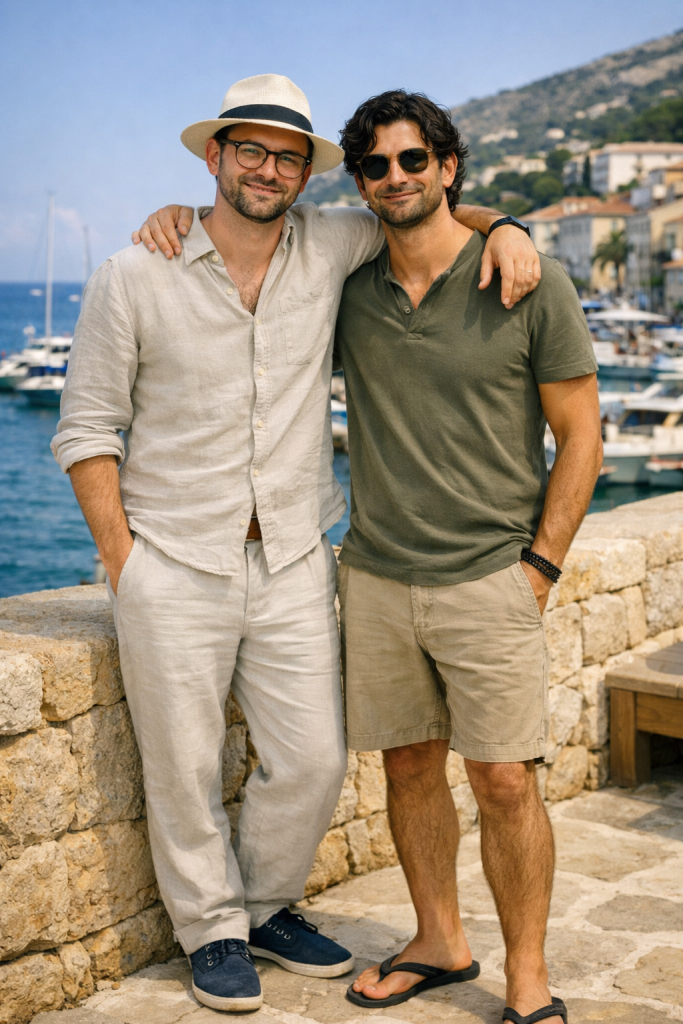
Elio’s Story
I grew up in Sicily, in a house full of sun and books. One of those books was L’Elfo e il Compagno Orco — the Italian edition of The Elf and the Orc. I didn’t know it was a translation. I didn’t know the English title was different. I didn’t know there was ever any doubt about the nature of their relationship.
In Italian, compagno means someone you belong with. Not a friend. Not a playmate. A partner.
So to me, Elf and Orc were a pair. A destined pair. A story written in two voices.
Years later, on a hot afternoon in Cefalù, I came out of the sea and went to buy a granita. At the kiosk, a sunburnt Englishman was apologising to the owner while trying to order “the lemon ice thing.” I corrected him — kindly, I thought — and he turned to me with a shy, bookish smile that made my heart tilt.
We talked. He told me his name: Jamie. He told me he worked in publishing. He told me his family ran a small press called Larkwing Books.
I froze.
Because Larkwing Books printed my book. My childhood book. My compagno book.
I stepped closer and said, “I grew up with one of your titles. L’Elfo e il Compagno Orco.”
Jamie laughed, delighted. “In English it’s just The Elf and the Orc. People always argued about whether they were—”
I interrupted him gently.
“There was never any argument.”
He blinked. “Oh?”
“In Italian,” I said, “compagno means someone you belong with.”
And in that moment — with the sea bright behind us and the granita melting in its cup — I knew exactly what the story was doing.
It was continuing.
Jamie’s Story
I was sixteen when I came out. It wasn’t dramatic. It wasn’t planned. It wasn’t even particularly brave. It was just a quiet evening in our kitchen, my mum making tea, me holding a book I’d just finished: The Cottage Beyond the Gate.
I’d read the last chapter twice. Then a third time. Then I walked downstairs, heart hammering, and said:
“Mum… I think I’m like Orc.”
She didn’t laugh. She didn’t look confused. She didn’t ask what I meant.
She just put the kettle down, came over, and hugged me. And that was it. That was my coming out.
So The Elf and the Orc has always been more than a book to me. It was the first story that made me feel seen — even before I understood why. And when Margaret Moore’s final volume revealed the truth Elf and Orc had carried all along, it felt like a door opening.
Years later, I found myself in Cefalù, sunburnt and tired and trying to order a granita in Italian. I was failing in the most English way possible when a voice beside me said:
“È più facile se dici ‘una granita al limone’.”
I turned.
And there he was — a man with wet hair, sun‑warmed skin, and a smile that made me forget every word of Italian I’d ever learned. He helped me order. We talked. His name was Elio.
I told him I worked in publishing. I told him my family ran Larkwing Books. I told him he probably hadn’t heard of it.
He went still — attentive, bright, like a door opening.
“I know Larkwing,” he said. “I grew up with one of your books.”
My heart did something strange.
“Really? Which one?”
He stepped closer. Salt and lemon and sunlight.
“L’Elfo e il Compagno Orco.”
I laughed. “That’s a lovely title. In English it’s just The Elf and the Orc. People always argued about whether they were—”
He stopped me with a look so gentle it felt like a hand on my shoulder.
“There was never any argument.”
I blinked. “Oh?”
“In Italian,” he said, “compagno means someone you belong with.”
And something inside me shifted — a compass needle swinging toward north.
Belong with.
I looked at him — really looked — and realised he wasn’t telling me about a book. He was telling me about us. About the moment we were standing in. About the story that had just begun.
The sea was bright. The air was warm. The granita melted in its cup.
And I thought:
So this is how a book brings two people together.